We’ve all watched it happen. A brilliant, agile engineering team builds a product that genuinely solves a painful problem. Developers love it. It’s fast, the architecture is elegant, and the pricing actually makes sense for the value delivered.
Fast forward five to seven years.
The company is now a dominant market incumbent with a massive valuation. But the software feels sluggish, the developer experience has tanked, and your monthly bill looks like a phone book.
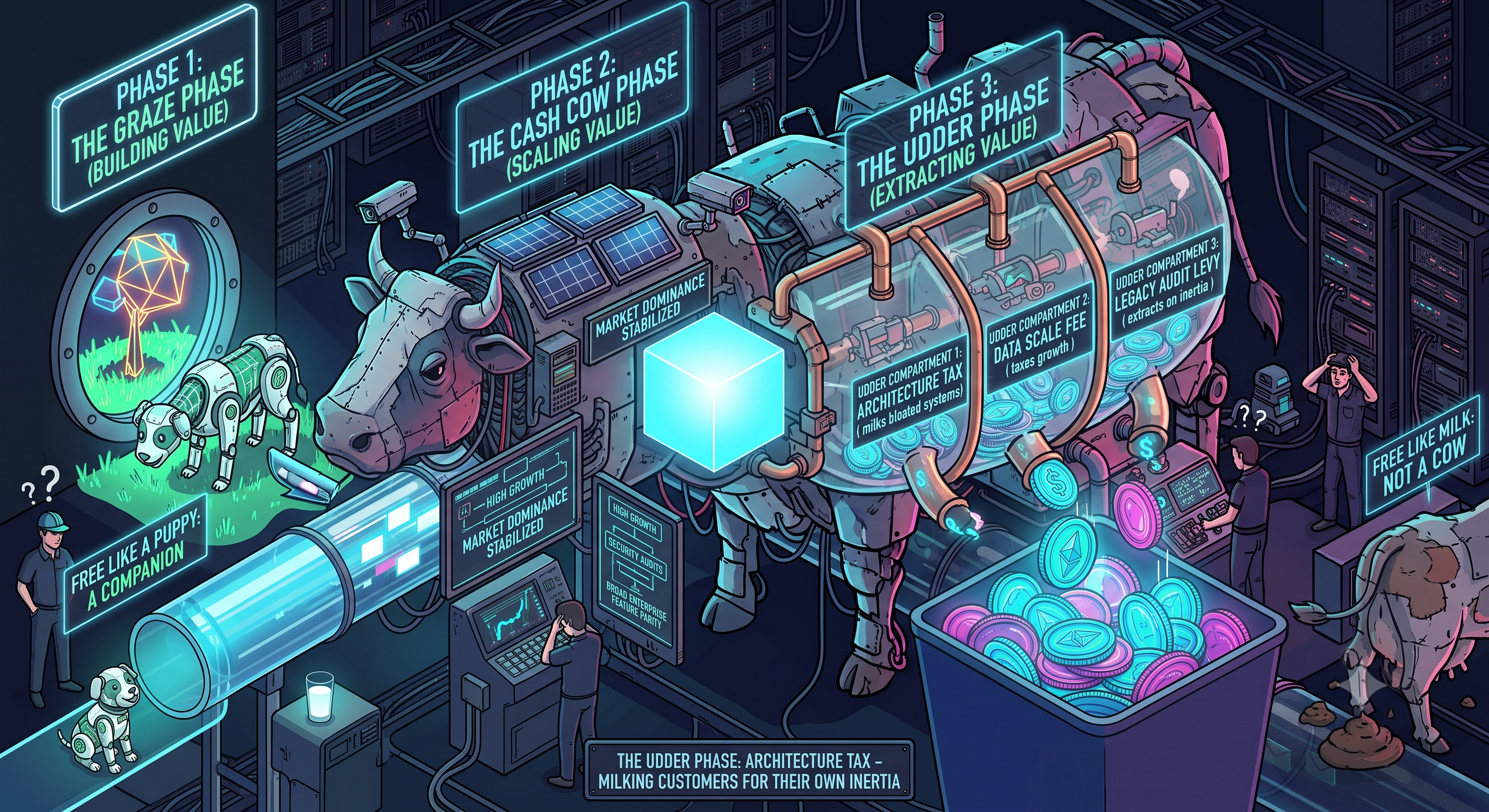
What happened? The company didn’t just lose its way; it completed a predictable corporate lifecycle pivot. It moved out of the value-creation business and entered the value-extraction business. It trapped itself at The Innovation Udder.
When a technology giant hits maturity, a dangerous realization sets in across the C-suite: Genuine engineering innovation is highly risky, but legacy customer extraction is a guaranteed quarterly return. It’s like dementia for an aging government—the imposing outward structure remains, but the core cognitive function is completely gone. Systemic bloat acts exactly like a massive software memory leak, eventually grinding the entire machine to a halt just to service the corporate garbage collector.
To understand how to navigate the modern enterprise vendor stack, you have to understand the three distinct phases of architectural and economic decay.
01. The Graze Phase (Building Value)
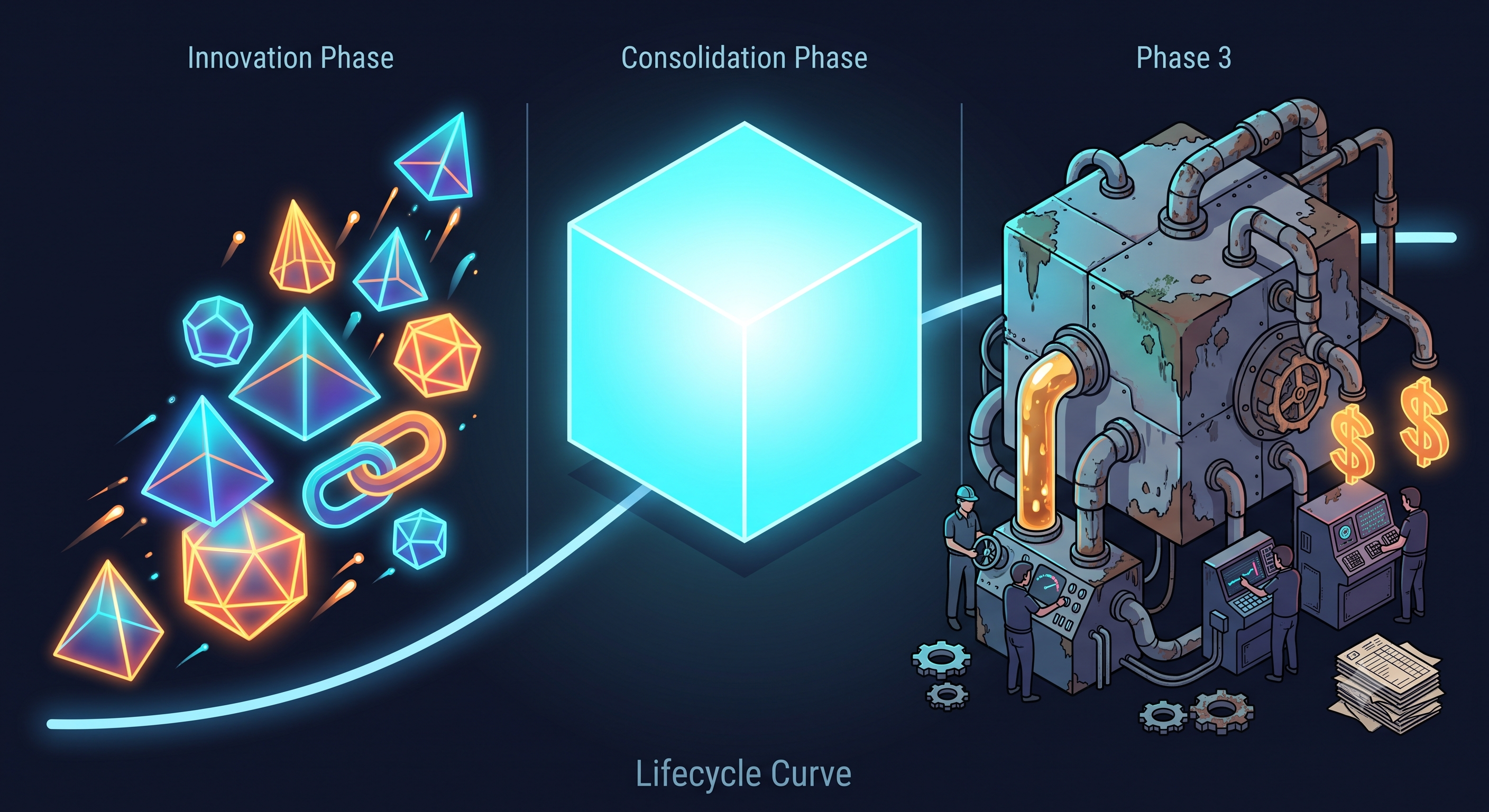
This is the golden era. The organization is actively grazing the market, looking for hard problems to solve. R&D velocity is exceptionally high.
- The Mindset: “How do we build the most elegant, hyper-efficient solution to this problem?”
- The Architecture: Lightweight, forward-looking, and built for modern scales (think edge processing, columnar storage, or friction-free APIs).
- The Revenue: Customers pay directly for the computational or functional utility they consume.
In the Graze Phase, engineers are the heroes. The product speaks for itself, and growth is driven by raw capability.
02. The Cash Cow Phase (Scaling Value)
The company has won the market. The product achieves dominant market share and stabilizes into a predictable, high-margin cash generator.
- The Mindset: “How do we scale our infrastructure to protect our core market share?”
- The Architecture: Fundamental shifts stop. Development focuses on security hardening, compliance, and broad enterprise feature parity.
- The Revenue: Steady, highly predictable contractual growth.
This is the healthiest financial period for the business, but it’s an architectural tipping point. The codebase grows massive, inertia sets in, and the legacy architecture starts dictating the company’s financial survival.
03. The Udder Phase (Extracting Value)
This is the dead-end. The company’s multi-billion-dollar valuation now rests entirely on a legacy, decades-old architectural model. True R&D drops to near zero, and the organization pivots fully to milking its captive user base.
The hallmark of the Udder Phase is a terrifying structural reality: The company can no longer afford to innovate.
If a giant trapped in this phase were to adopt a modern, hyper-efficient architecture that reduces data footprints or processes workloads instantly, they would actively vaporize their own bottom line. They literally charge you a premium because their system is inefficient. When a vendor enters the Udder Phase, engineering takes a back seat. The core drivers of the business become sales enablement and legal compliance.
04. The Diagnostic Checklist: Is Your Vendor Milking You?
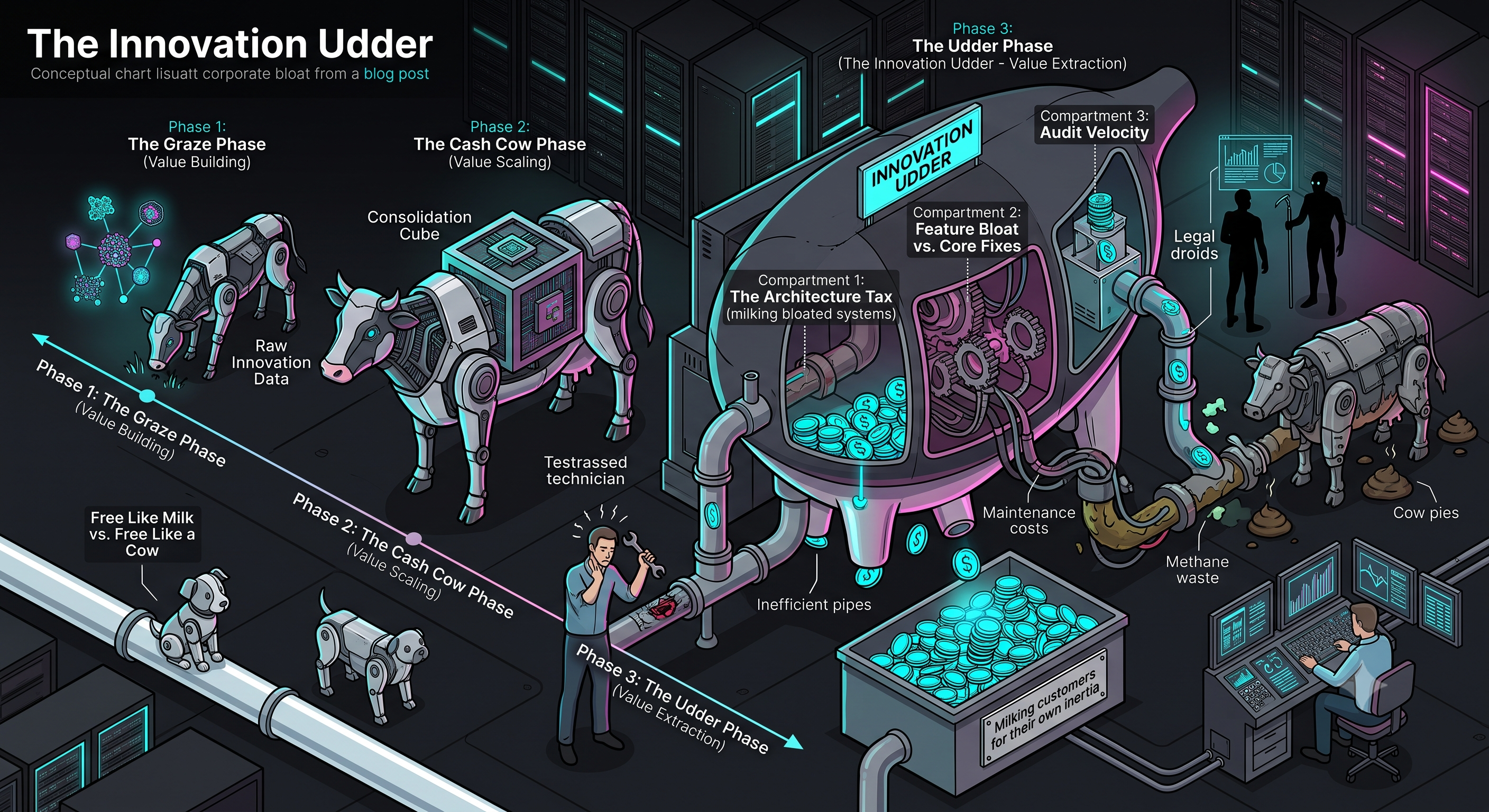
You can spot an enterprise company trapped at the Udder by looking for three systemic warning signs:
- The Architecture Tax: They make it incredibly expensive to move, process, or scale your own data. The pricing model is intentionally decoupled from hardware costs to protect historical software margins.
- Feature Bloat vs. Core Fixes: Release notes are filled with wonky enterprise bundles and governance wrappers, while foundational developer experience (DevEx) bugs sit open in GitHub issues for three years.
- Audit Velocity Outpaces Feature Velocity: You interact more frequently with their compliance auditors checking your seat allocations than you do with their product managers asking for feedback.
05. The Cloud Era Reality: Free Like Milk vs. Free Like a Cow
We used to debate whether software was “free like a puppy” (requires constant care) or “free like beer” (great at first, leaves a headache later).
In the modern cloud ecosystem, the dilemma has evolved. It’s a choice between Free like Milk vs. Free like a Cow.
Choosing a vendor trapped at the Innovation Udder means you aren’t buying a dynamic engineering engine; you are buying into a system designed to tax your corporate inertia.
The next time you review your enterprise software architecture stack, take a hard look at where the capital is flowing. Are you funding a team that is actively grazing the frontier of engineering? Or are you just paying an extraction tax to keep a legacy cash cow comfortable?
Marc Sherwood is a Technical GTM consultant and the founder of HoneOS.ai, where he helps software organizations build growth pipelines that avoid the legacy extraction trap entirely.