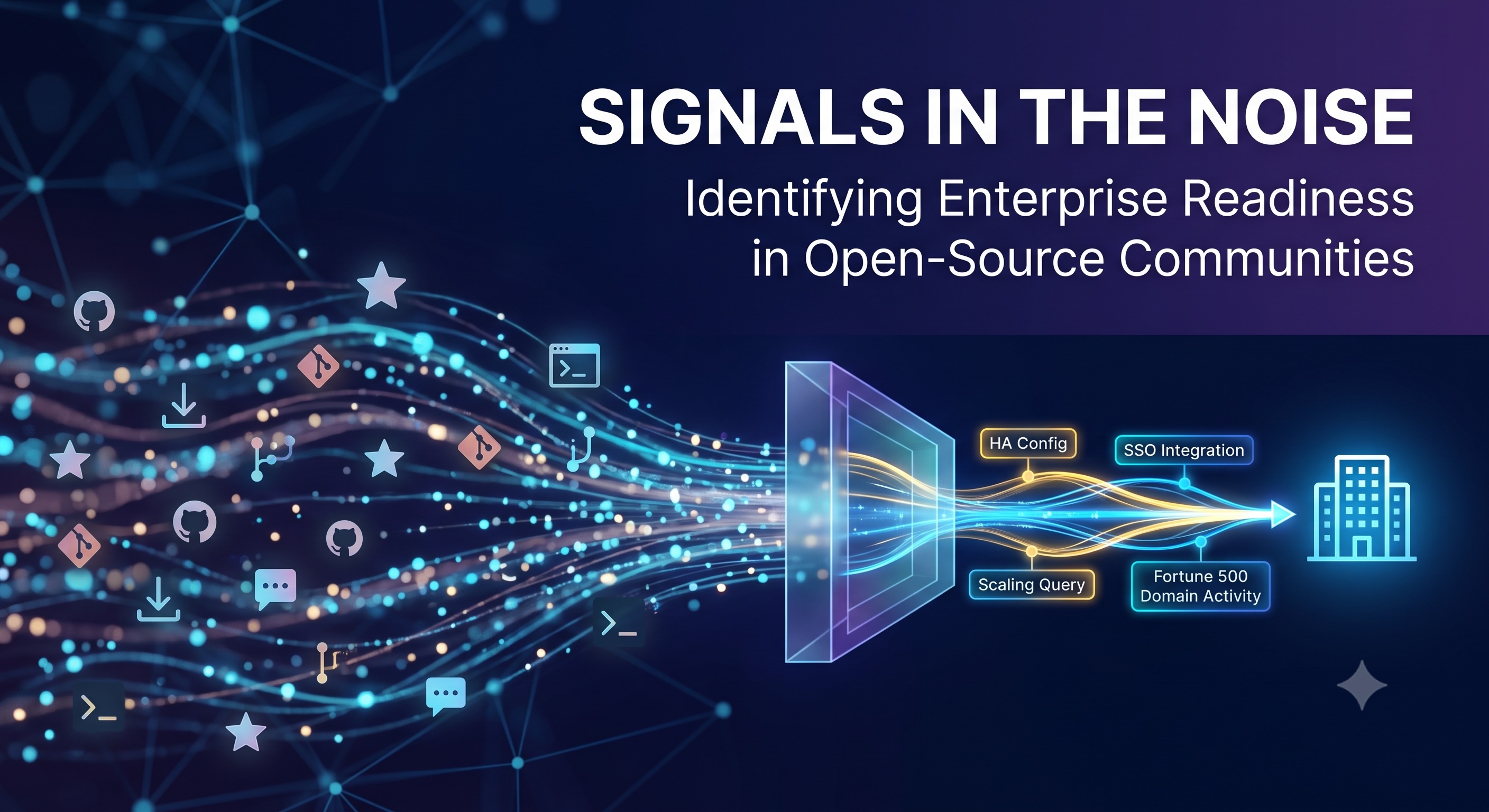
TL;DR: Community goodwill is a moat, but it isn’t a pipeline. High Docker pulls and GitHub stars often mask a broken Go-To-Market strategy, leading to inflated MQL costs, burned-out sales teams, and panicked license changes. To convert open-source adoption into enterprise revenue, companies must shift from traditional community evangelism to dedicated Customer Marketing. This piece breaks down how to stop bloating your free core, avoid the “license panic” trap, and build a commercial intelligence framework—tracking identity, intent, and account gravity—that hands your sales team actionable context instead of anonymous contacts.
The Illusion of Momentum and the Cost of Noise
Everyone loves a rising GitHub star graph and a spike in Docker pulls. They look great on a pitch deck, and an active community feels like inevitable momentum. But as the open-source landscape matures, a hard truth is settling in: community goodwill is a moat, but it is not a pipeline.
We are quick to dismiss these numbers as “vanity metrics” when they don’t immediately translate to revenue. But the reality is they are only vanity metrics if they aren’t understood and acted upon in a smart fashion.
When you fail to act on them strategically, the situation actually feels significantly worse. You can see the community love. You have a compelling commercial open-source (COSS) conversion story. Yet, the conversion rates from an anonymous download to a Marketing Qualified Lead (MQL), and eventually to a Sales Qualified Lead (SQL) and pipeline opportunity, simply aren’t viable.
This misalignment creates a massive financial drag. Every time you try to force raw community volume into a traditional sales funnel, you drive up the cost of goods sold (COGS) for your MQLs. You end up paying heavily—in marketing spend, tooling, and SDR hours—for the wrong leads.
Worse than the financial cost is the operational damage: handing a raw lead to your sales team without giving them the “why.” Telling an account executive that a developer pulled a Docker image gives them no leverage. Without the commercial intelligence to explain why that specific pull matters—perhaps it was the fifth pull this week from a Fortune 500 domain, or it followed a deep dive into enterprise clustering documentation—you are sending your team in blind.
The challenge isn’t that enterprise buying signals don’t exist in your open-source data. It’s that without a framework to filter the noise, you are optimizing for volume instead of readiness, inflating your acquisition costs, and burning out your Go-To-Market team in the process.
The GTM Pivot: Moving from Evangelism to Intelligence
For years, the default playbook for open-source Go-To-Market relied heavily on the “Ambassador.” This role was designed for evangelism—driving awareness, speaking at conferences, managing community forums, and celebrating those rising download metrics. Ambassadors are exceptional at building top-of-funnel hype and community goodwill, but their metrics rarely align with pipeline generation. In fact, they generate the exact raw volume that ultimately drives up your MQL costs when dumped unfiltered into a CRM.
When you rely on an Ambassador motion to feed a sales pipeline, you are asking a megaphone to do the job of a microscope.
Bridging the gap between a free community and a commercial product requires a fundamental shift in how you categorize and execute this function. It requires moving away from the generalized Ambassador model and deploying a dedicated Customer Marketing approach. This isn’t just a change in terminology for a strategic plan; it is a vital pivot from generating noise to synthesizing intelligence.
Uncovering the “Why” for Sales
The core mandate of Customer Marketing in an open-source context is to act as the translation layer between raw community telemetry and enterprise sales execution. Where an Ambassador sees a “highly active community member,” Customer Marketing looks for the commercial narrative.
To fix MQL conversion rates and stop burning out your sales team, Customer Marketing provides the missing context—the “why”—by answering critical questions before an Account Executive ever initiates contact:
- What scaling limits are they hitting? A developer asking about high-availability configurations, multi-region routing, or long-term data retention is no longer just tinkering; they are preparing for production.
- What is the integration context? If a user is actively researching how to plug your open-source tool into enterprise-grade SSO, role-based access control (RBAC), or legacy internal systems, the intent has shifted from exploration to enterprise implementation.
- Where is the gravity? Mapping an anonymous handle or a frequent GitHub contributor to a specific enterprise domain, and noticing when multiple engineers from that same domain start participating simultaneously.
By taking ownership of this intelligence layer, Customer Marketing transforms a generic, high-cost MQL into a highly targeted, context-rich opportunity. This arms your sales team with a specific, value-driven reason to reach out. They aren’t cold-calling to awkwardly ask, “How are you enjoying the free tool?” They are reaching out as strategic partners to solve a documented scaling challenge.
The Balancing Act: Where COSS Models Break Down
Understanding the telemetry of your community is only half the battle. The other half is ensuring you actually have something valuable to sell when those enterprise signals fire.
When the Go-To-Market strategy is misaligned with the product strategy, commercial open-source companies typically fall into one of two fatal traps. They either give away so much that they destroy their own pipeline, or they starve the open-source version so severely that they kill the community before it can grow.
Trap 1: Giving Away the Farm (and Bloating the Core)
This is the most common trap for engineering-led founders. Driven by the desire to build the absolute best tool and maximize adoption, they pack the open-source tier with complex, enterprise-grade features: advanced clustering, multi-tenant RBAC, and niche integrations.
This breaks the Go-To-Market model in two distinct ways:
First, it overcomplicates the core product. The beauty of successful open-source infrastructure is almost always its simplicity and out-of-the-box performance. When you bake highly complex features—designed specifically for a fraction of massive enterprises—into the free core, everyday users will turn them on simply because they are available. This introduces unnecessary friction, deployment issues, and a massive support burden on the community. You take a beautifully simple, performant solution and make it fragile for the vast majority of users who never needed that complexity in the first place.
Second, it destroys your commercial leverage. When the Customer Marketing team finally identifies a Fortune 500 company using the product in production, the sales team has nothing left to offer. The enterprise already has everything it needs to scale. Your sales team isn’t selling software at that point; they are asking for donations. You end up relying on “Thank You” purchase orders from guilty engineering managers who want to throw a few bucks your way to ensure you keep maintaining the free tool. A business model built on gratitude is not a business model.
The golden rule for product alignment: The open-source core must remain brutally simple and highly performant. “Enterprise” features should explicitly be those complex layers—compliance, advanced security, massive-scale orchestration—that only an enterprise actually needs.
Trap 2: Starving the Open-Source Core
On the opposite end of the spectrum is the “crippleware” approach. Panicked by the prospect of giving away too much, companies heavily restrict the open-source version. They lock basic table-stakes functionality behind a massive paywall, or they funnel 100% of their new R&D into the proprietary cloud offering while letting the open-source repository stagnate.
The market immediately sees through this. If the open-source version is too painful to use, or clearly abandoned in favor of the cloud product, developers will never adopt it. The Trojan Horse never makes it past the gates, and the entire top-of-funnel engine collapses.
The Breaking Point: License Panic and Community Revolt
When a COSS company gives away too much and fails to build a sustainable pipeline, the inevitable result is a violent course correction. Over the last few years, we have watched some of the biggest names in infrastructure hit the limits of their monetization strategies and pull the ripcord on their licensing.
We saw this when Elastic transitioned to the Server Side Public License (SSPL), HashiCorp moved Terraform to the Business Source License (BSL), and Redis abandoned the BSD license. CockroachDB followed a similar path.
These licensing shifts are almost always framed as a defense against cloud providers, but they are often a symptom of a deeper Go-To-Market failure. When the open-source product is so complete that enterprises don’t need the commercial tier, the monetization engine breaks. The resulting community backlash is brutal and swift, often resulting in hard forks (OpenSearch, OpenTofu, Valkey).
Changing your open-source license is a desperate attempt to retroactively fix a broken Go-To-Market strategy. The true solution isn’t to pull the rug out from under your community; it is to build a commercial intelligence engine that understands exactly when and why an enterprise needs to upgrade, and ensuring your product tiers reflect that journey.
Defining the Signals: A Framework for Commercial Intelligence
Recognizing that open-source telemetry holds the key to enterprise sales is the first step. The second, much harder step, is building a systematic engine to capture, enrich, and score that data without violating the trust of your community.
Developers are highly sensitive to being tracked or marketed to. A successful commercial intelligence framework doesn’t rely on invasive surveillance; it relies on smartly aggregating and interpreting the digital exhaust that users voluntarily leave behind in public or semi-public spaces—GitHub issues, community channels, forum posts, and documentation telemetry.
To turn noise into actionable pipeline, your Customer Marketing engine needs to process telemetry through three distinct layers:
1. Identity Resolution: De-anonymizing the Domain
The fundamental challenge of open-source Go-To-Market is fragmented identity. A single developer might be DarkKnight99 on Discord, j-smith-dev on GitHub, and a generic IP address downloading a Docker image.
Before you can score a signal, you have to attach it to an entity. This involves correlating community profiles with corporate domains. It means looking at the email domains used to register for the community forum and analyzing the domains associated with GitHub commits. You aren’t trying to build a dossier on a single developer; you are trying to answer one specific question: Is this user representing a hobby project, or are they evaluating on behalf of a target enterprise?
2. The Signal Hierarchy: Categorizing Intent
Not all community engagement is created equal. A GitHub star is a low-fidelity signal. A detailed bug report about a multi-node cluster failure is a massive, high-fidelity signal. You must categorize telemetry based on the phase of adoption it represents:
- Exploration Signals (Low Intent): Docker pulls, GitHub stars, repository forks, and basic “getting started” questions. These are necessary for top-of-funnel health but should rarely trigger a sales motion.
- Production Signals (Medium Intent): Opening highly specific issues, contributing minor PRs, or asking forum questions about optimizing queries, indexing, or basic deployment architecture. They are using the software seriously, but perhaps not at a scale that requires an enterprise contract.
- Enterprise Scaling Signals (High Intent): This is the goldmine. These are users actively asking about or attempting to configure high availability, cross-region replication, SAML/SSO integration, Role-Based Access Control (RBAC), or integrations with enterprise observability tools. These signals loudly declare: “We are putting this into a mission-critical environment, and we have compliance and scaling requirements.”
3. Account Gravity and Velocity
A single high-intent signal from one developer is a great lead. Three medium-intent signals from three different developers at the same target enterprise within a two-week window is a commercial mandate.
We call this Account Gravity. Open-source adoption within an enterprise rarely happens in a vacuum. It starts with one developer, spreads to a small team, and eventually hits the infrastructure or platform engineering group. By tracking the velocity of new users from the same domain joining your community, and measuring the density of their interactions, you can pinpoint the exact moment a grassroots tool is becoming an official corporate standard.
The Handoff: Context over Contacts
When an account crosses the scoring threshold—combining identity, high-intent signals, and account gravity—it triggers the handoff from Customer Marketing to Sales.
But you don’t hand the Account Executive a spreadsheet of names. You hand them a context brief:
“Over the last 14 days, four engineers from [Target Enterprise] joined the community. Two of them have been asking deep technical questions about configuring multi-tenant RBAC and scaling storage nodes. They are clearly hitting the limits of the open-source core and are preparing for an enterprise deployment.”
With this framework in place, your sales team is no longer burning goodwill by blindly calling developers to ask for a meeting. They are stepping in exactly when they are needed, armed with the context to solve a complex engineering problem.
The Hard Part: Operationalizing the Intelligence
Understanding this framework is easy; operationalizing it is where most organizations fail. Signals are absolutely worthless without the infrastructure for collection, the logic for correlation, and the strategic vision to actually act on them.
You cannot simply buy a traditional CRM, plug it into your community spaces, and expect enterprise deals to fall out. Building this intelligence engine requires moving away from static funnels and adopting an iterative, engineering-minded loop:
- Spot: Passively identifying friction points and scaling limits within the community telemetry.
- Test: Formulating a Go-To-Market hypothesis around what that specific account is trying to achieve (e.g., “They are asking about node communication; they are likely trying to build a multi-region cluster”).
- Solve: Deploying the Customer Marketing or Solutions Engineering team to remove that immediate technical blocker, proving value without a hard sales pitch.
- Test (Again): Introducing the enterprise capabilities as the logical next step to their solution.
- Expand: Bridging the gap to the sales team with full context to secure the commercial contract.
Executing this loop requires a highly specific capability. It demands a hybrid operator who understands the deep technical nuances of infrastructure software while possessing the commercial acumen to navigate an enterprise sales cycle. It is the exact reason I transitioned from traditional technical marketing and ambassador roles into building dedicated Customer Marketing and Go-To-Market functions for infrastructure companies.
It is also the core thesis behind HoneOSS—the commercial intelligence platform I am developing to help open-source organizations automate this exact process of collection, identity resolution, and signal correlation.
Conclusion: Stop Flying Blind
The companies that will dominate the next decade of infrastructure software won’t be the ones with the highest vanity metrics, the loudest community servers, or the most aggressive license changes. They will be the organizations that stop treating their community as a black box and start treating it as a signal-rich environment.
If you are sitting on massive community goodwill, a beautifully simple open-source core, and a compelling enterprise tier, but you are still struggling to build a viable, cost-effective pipeline—your open-source model isn’t broken. Your telemetry is.
It is time to stop paying for the wrong MQLs, stop burning out your sales team on blind outreach, and start listening to the signals hidden in the noise.